Why Do Construction Crews Need Rough Cleaning Before the Final Cleaning Stage?
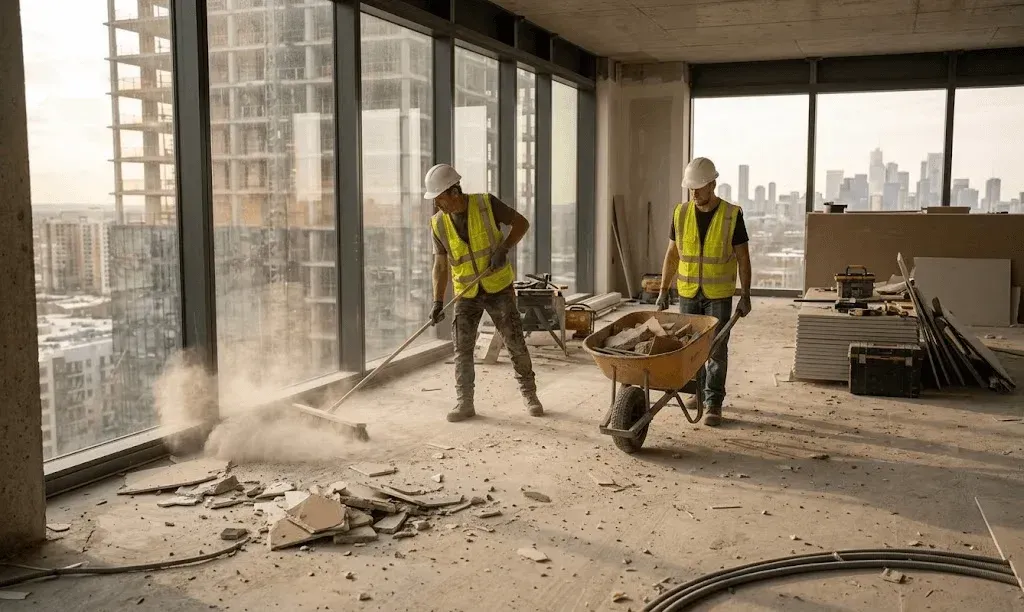
Table of Contents
- Introduction
- What Rough Cleaning in Construction Actually Removes
- The Post-Construction Cleanup Stages, in Order
- Rough Clean vs. Final Clean: What Separates Them
- What Happens on Projects That Skip Rough Cleaning
- When Rough Cleaning Should Happen in the Build Schedule
- Who Is Responsible for Rough Cleaning on a Project
- What the Construction Final Clean Covers
- How Rough Cleaning Differs From Make-Ready Cleaning
- What to Have Ready Before a Rough Clean Crew Arrives
- Conclusion
- Get a Quote for Rough Cleaning on Your Next Project
- Frequently Asked Questions
Key Takeaways
- Rough cleaning removes heavy debris, construction dust, adhesive residue and stickers so the final clean can focus on polish and presentation rather than demolition-level grime.
- They are two different jobs with different tools and different crews' worth of labour. Trying to do both in one pass produces a worse result and usually costs more.
- Skipping rough cleaning is why final cleans get rejected. Dust that was never removed keeps resettling on surfaces the crew already finished.
- Sequencing matters more than thoroughness. Rough cleaning before flooring, fixtures and paint touch-up is cheap; after them it risks damage.
- Rough cleaning and make-ready cleaning are not the same thing. Make-ready prepares a finished space for a tenant or an opening, and it assumes the construction grime is already gone.
Introduction
Construction crews need rough cleaning before the final cleaning stage because the two stages remove completely different things. Rough cleaning clears heavy construction debris, thick dust, adhesive residue, stickers and labels off surfaces so the final clean can focus on polish and presentation instead of demolition-level grime. Attempt to do it in one pass and the dust you failed to remove from ductwork, ledges and framing keeps settling onto the surfaces you just detailed.
The term trips up a lot of people who are not in the trades. General contractors and property managers search for what rough cleaning means and rarely find it defined in plain language, so here is the sequence, what belongs in each stage, and where projects go wrong.
What Rough Cleaning in Construction Actually Removes
Rough cleaning is the heavy pass. It happens while a building is still, functionally, a construction site, and its purpose is to produce a clean, construction-ready canvas for the trades still to come and for the detail clean that follows.
The work typically covers:
- Leftover construction debris: offcuts, packaging, banding, broken material, fasteners and general jobsite trash
- Heavy surface dust, particularly drywall and sanding dust, which is fine, pervasive and gets everywhere
- Dust on horizontal ledges and high surfaces such as beams, ductwork, tops of door frames, window heads and mechanical runs
- Adhesive residue, stickers and labels left on windows, glass, fixtures, appliances and cabinetry
- Paint overspray, drywall mud splatter, joint compound and caulk smears
- Grout haze and mortar residue on hard surfaces
- Floor debris and protective covering removal
- Sweeping and rough vacuuming of all floor areas, including stairwells and mechanical rooms
Prior to the final cleaning procedure, the point is to scour every surface and leave no stone unturned, which is a fair description of what the pass involves. It is physical, dusty work, and it is not the same skill set as detailing.
The Post-Construction Cleanup Stages, in Order
Most commercial projects move through three or four cleaning stages. Terminology varies between contractors, but the sequence is consistent:
- Ongoing jobsite housekeeping. Trade-by-trade cleanup during the build, usually handled by the subs themselves. Keeps the site workable and safe, not presentable.
- Rough clean. The heavy pass described above, once the majority of dusty work is finished but before final finishes go in.
- Final clean. The detail pass: glass, fixtures, floors, restrooms, polishing and presentation.
- Touch-up or punch clean. After the punch list is worked, since correcting punch items generates new dust and marks. Often overlooked at bid time and then needed anyway.
That fourth stage is worth building into the schedule rather than discovering. Any project with a substantial punch list will need a touch-up pass, and it is cheaper to plan it than to argue about it during turnover.
| Rough clean | Final clean | |
|---|---|---|
| Purpose | Remove bulk debris and dust | Presentation and polish |
| When | Before final finishes and fixtures | After all trades are finished |
| Site condition | Still an active construction site | Substantially complete |
| Typical work | Debris haul, heavy dust, adhesive residue, sweeping | Glass, fixtures, floors, restrooms, detailing |
| Tools | Shop vacuums, scrapers, heavy-duty gear | Detail supplies, floor equipment, finishing products |
| What "done" looks like | Ready for finishing trades | Ready to hand over |
| Who usually sees it | The trades | The owner, tenant or inspector |
The row that matters most is the last one. A final clean is judged by whoever accepts the building, which is why sending a detail crew into an environment that still needs a rough pass wastes their time and produces a result that fails inspection anyway.
What Happens on Projects That Skip Rough Cleaning
We see the same failures, and all of them trace back to compressing two stages into one:
- Dust resettles onto finished surfaces. This is the big one. Fine drywall dust sitting on ductwork, ledges and above ceilings drifts down for days. A detail crew cleans a lobby, the HVAC runs, and it looks untouched the next morning.
- The final clean gets rejected, and somebody has to pay for a second pass. That argument usually happens at the worst point in a project.
- Adhesive residue becomes permanent. Stickers and labels left on glass through weeks of sun are far harder to remove than they were on day one, and aggressive removal at that stage risks scratching.
- Grout haze sets. Left too long, it stops being a cleaning problem and becomes a restoration problem.
- Finishes get damaged. Dragging debris and running heavy equipment across newly installed flooring is how scratches and chips appear.
- Turnover slips. Cleaning is the last thing on the schedule, so every problem in it pushes the handover date directly.
- Dust loads into the HVAC system, which then distributes it through the finished building.
None of that is exotic. It is the predictable result of treating cleaning as one line item instead of a sequence.
When Rough Cleaning Should Happen in the Build Schedule
The timing rule is simple: rough clean after the dusty work is done and before the finishes that dust would ruin.
In practice that means after framing, drywall hanging, taping and sanding, after mechanical and electrical rough-in, and after the bulk of cutting and grinding. It should come before final flooring where possible, before fixtures, appliances and finish hardware are installed, before final paint touch-up, and before any detail cleaning.
Two notes from experience. On larger projects, rough cleaning is often better done in phases by area rather than all at once, so finishing trades can move into a clean zone while other zones are still rough. And on fast-track schedules where flooring goes in earlier than ideal, protection matters more and the rough pass has to be planned around what is already installed.
The cost logic is worth stating plainly. Rough cleaning before flooring and fixtures is inexpensive. The same work after them is slower, riskier and sometimes damages what it is cleaning around.
Who Is Responsible for Rough Cleaning on a Project
This is where disputes come from, and it is usually a contract question rather than a practical one.
Ongoing housekeeping is normally each subcontractor's own responsibility for their own debris, and most subcontracts say so. Rough cleaning and final cleaning are usually the general contractor's scope, subcontracted to a cleaning company. Touch-up after punch is the stage most often left undefined, which is exactly why it turns into a change order.
If you are writing or reviewing a scope, the questions worth settling in advance are which stages are included, whether debris haul-off and disposal are part of the price or separate, whether the work is priced by phase or as one lump sum, who provides water and power on site, and whether touch-up after punch is included or additional. Getting those in writing costs nothing at bid time.
What the Construction Final Clean Covers
The construction final clean is the presentation pass, and it is what the owner or tenant actually judges. Typical scope:
- Interior and exterior glass, frames, tracks and sills
- Detail dusting of all surfaces, including high and low reach
- Fixtures, hardware, switch plates and vents
- Restrooms cleaned and sanitized to a finished standard
- Kitchens and break areas, including appliance interiors
- Cabinetry inside and out
- Floor care appropriate to the material, whether that means final mopping, buffing or carpet cleaning
- Spot removal of any remaining residue, marks and smudges
- Final debris removal
This is where the difference between the two stages becomes obvious. Everything above assumes the heavy grime is already gone. A crew doing this work should be detailing, not excavating. Where a project needs both stages covered, they sit together under construction and post-construction cleanup as one continuous scope rather than two disconnected bookings.
How Rough Cleaning Differs From Make-Ready Cleaning
These get conflated, and they are genuinely different products.
Rough cleaning happens during construction and prepares a building for finishing work. Make-ready cleaning happens after construction and prepares a finished space for a tenant, a buyer or an opening. Make-ready assumes the construction grime is gone and the space is essentially complete.
Make-ready work suits apartment turnovers, restaurant openings, commercial move-ins and renovated offices or retail spaces, where the point is that the space feels brand new on handover day. On a new build or a gut renovation you may well need all three: rough, final, then make-ready ahead of the tenant walking in. On a light refresh with no dusty trade work, make-ready alone may be the whole job.
Once a building is occupied, the need changes again from project cleaning to recurring upkeep, and that is where a daily, weekly or monthly janitorial schedule takes over from one-time construction work.
What to Have Ready Before a Rough Clean Crew Arrives
Small things that make a significant difference to how fast the pass goes:
- Water and power on site, or advance notice that neither is available
- A dumpster with capacity, or a clear agreement on where debris goes
- Site access and keys, including after-hours arrangements if the work is outside normal trade hours
- A clear answer on what stays, since materials stored on site look a lot like debris to a cleaning crew
- Confirmation of which trades are still working and in which areas
- Any protective covering you want left in place flagged in advance
- Elevator or hoist access on multi-storey work
- A named point of contact on site who can make decisions
The one that causes the most lost time is the fourth. If stored materials are not clearly separated or labelled, a crew either stops to ask about everything or risks throwing out something that matters.
Conclusion
Rough cleaning exists because construction produces two completely different cleaning problems. The first is bulk: debris, heavy dust, adhesive and residue that has to come out before finishes go in. The second is detail: the glass, fixtures, floors and surfaces the owner inspects on handover day.
Run them as one stage and the dust from the first ruins the work of the second. Run them in order, with the rough pass scheduled before flooring and fixtures, and the final clean does what it is supposed to do. Then settle in writing who owns each stage, including the touch-up pass after punch, because that is the one that turns into an argument.
Get a Quote for Rough Cleaning on Your Next Project
If you have a build coming up, the useful conversation happens before the schedule is locked. We can look at the project, tell you which cleaning stages it actually needs, and price them by phase so rough, final and any touch-up pass are all accounted for rather than discovered late.
Tucker Pros handles rough cleaning for commercial construction across Mansfield, Grand Prairie and the greater DFW area. Our team is trained, equipped and experienced to clean all types of commercial properties, and we tailor every cleaning plan around your schedule, budget and building type.
Call
(214) 680-6059, email
info@tuckerpros.com, or book a time online. Office hours are 8:00 AM to 5:00 PM.
Frequently Asked Questions
Is rough cleaning the same as construction debris removal?
Not quite. Debris removal is part of it, but rough cleaning also covers heavy dust on ledges and high surfaces, adhesive residue and stickers, and splatter from mud, paint and grout. Hauling the trash out is the start of the pass rather than the whole thing.
Can one crew do rough and final cleaning together in a single visit?
It is possible but rarely produces a good result. Dust left in ductwork and on high surfaces keeps resettling, so a combined pass often means paying for a second final clean anyway. Separating the stages is usually cheaper overall.
How long after rough cleaning should the final clean happen?
After all trades are finished, not before. If finishing work continues after the final clean, it generates new dust and marks and you will need a touch-up pass. Scheduling the final clean against actual trade completion matters more than a fixed interval.
Does rough cleaning include removing stickers from windows and appliances?
Yes, that is squarely part of the pass. It is also worth doing early, since adhesive that has sat through weeks of sun becomes much harder to remove and aggressive removal at that point risks scratching the glass.
Who typically pays for rough cleaning, the GC or the subcontractors?
Subcontractors usually handle their own ongoing housekeeping, while rough and final cleaning are typically in the general contractor's scope and subcontracted out. Confirm it in the contract, particularly the touch-up pass after punch, which is the stage most often left undefined.
Recent Posts